Do Guardian Caps Actually Prevent Concussions? What the Science Says
If you’ve watched football recently, you’ve probably noticed more players wearing oversized, padded covers over their helmets. These are called Guardian Caps, and they have become increasingly common from youth and high school football all the way to college programs and the NFL.
The idea behind them seems simple enough: add another layer of padding to the outside of a football helmet, absorb more energy during a collision, and hopefully reduce the risk of a concussion. From a physics standpoint, that makes sense. But in medicine, something that makes sense in theory doesn’t always produce the outcome we expect in the real world.
So, do Guardian Caps actually prevent concussions?
The answer is more complicated than a simple yes or no. Laboratory research suggests Guardian Caps can reduce some of the forces generated during helmet impacts. However, when researchers have studied actual football players on the field, the results have been considerably less convincing.
At Flex Health in Evans, Georgia, where we provide sports medicine and concussion care for athletes throughout the Augusta area and CSRA, we think this distinction is important. Parents and athletes deserve to understand what the research actually shows, not just the marketing surrounding a piece of equipment.
What Exactly Is a Guardian Cap?
A Guardian Cap is a soft, padded shell that fits over a traditional football helmet. It doesn’t replace the helmet. Instead, it provides another compressible layer between the helmet and whatever it strikes.
The concept is relatively straightforward. When two helmets collide, energy is transferred through the helmets and ultimately to the players’ heads. Adding a layer of compressible material may absorb or dissipate some of that energy before it reaches the head.
That basic principle is not particularly controversial. Protective equipment throughout sports is designed around similar concepts.
The difficult question is whether reducing certain forces during a controlled collision translates into fewer brain injuries during actual football. That’s where we have to distinguish between improving impact biomechanics and preventing a clinical concussion.
A concussion isn’t simply caused by exceeding one particular number on an impact sensor. The biomechanics are much more complicated. Linear acceleration, rotational acceleration, impact direction, the location of the impact and individual susceptibility can all play a role. Previous concussion history and other individual factors may matter as well.
That’s why showing that a product reduces impact forces doesn’t automatically prove that it prevents concussions.
In the Laboratory, Guardian Caps Appear to Help
The strongest evidence supporting Guardian Caps comes from laboratory testing.
Researchers can mount football helmets onto specialized testing equipment and recreate impacts under controlled conditions. This allows them to compare a helmet alone with the same helmet wearing an external padded cover.
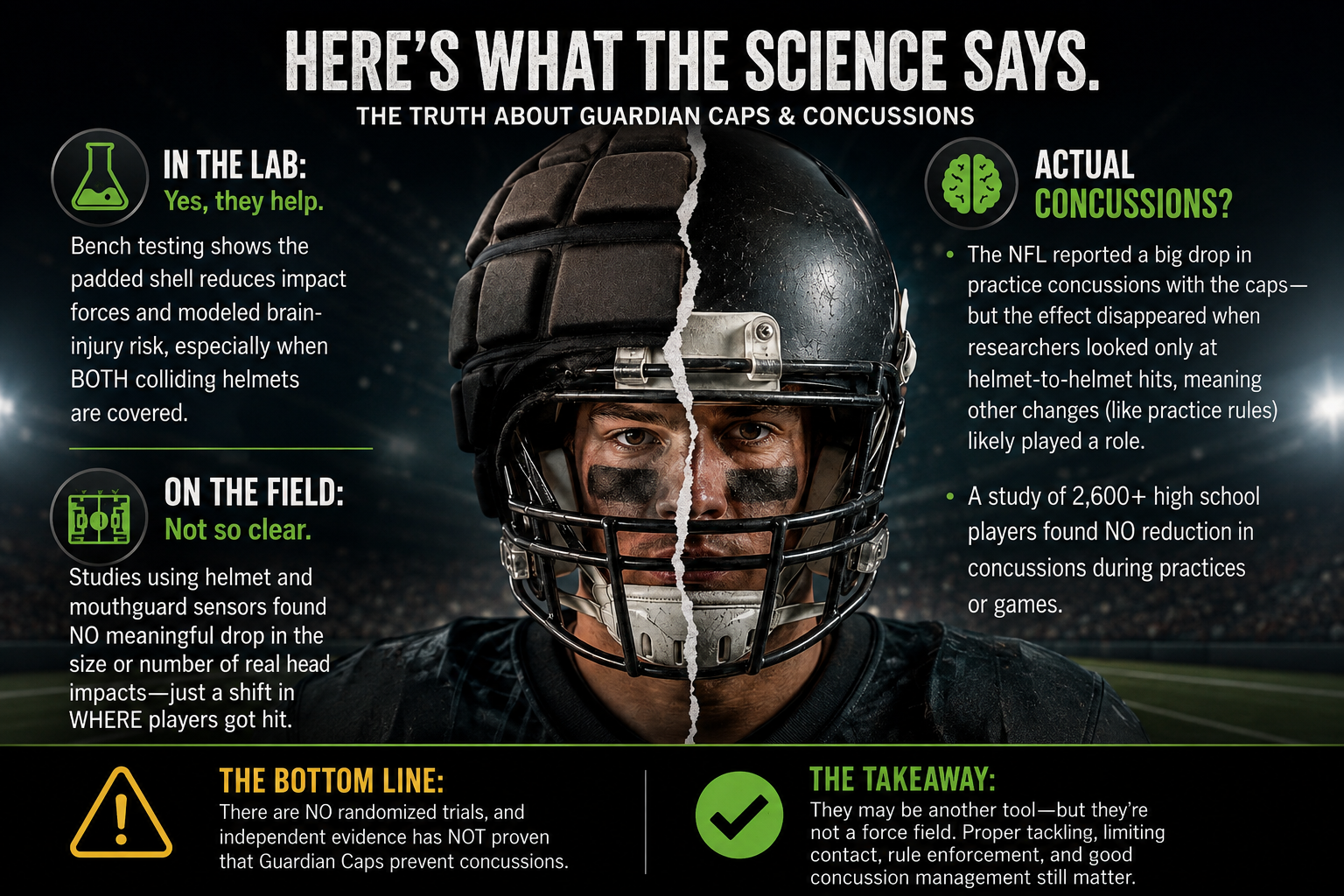
These studies have demonstrated that padded helmet shells can reduce certain measures of impact severity, including linear and rotational acceleration and modeled measures of head-injury risk under some testing conditions. Research published in the Annals of Biomedical Engineering has provided evidence that external helmet padding can reduce impact forces, although the amount of protection varies depending on factors such as the helmet model, impact location and collision characteristics.
One particularly interesting finding is that the benefit may be greater when both helmets involved in a collision are wearing padded covers. That makes intuitive sense. Instead of two relatively hard helmet shells colliding, there are now compressible layers available to absorb some of the energy on both sides of the collision.
If the question is simply, “Can Guardian Caps reduce certain forces during controlled helmet impacts?”, the answer appears to be yes.
But football isn’t played in a laboratory.
What Happens When Players Wear Guardian Caps on the Field?
Real football collisions are far more complicated than laboratory testing. Players move at different speeds, collide from unpredictable directions and strike each other with different parts of their helmets and bodies. A helmet might hit another helmet, a shoulder, the torso or the ground. Some impacts are primarily linear, while others cause substantial rotation of the head.
Researchers have therefore begun using technologies such as instrumented mouthguards and helmet sensors to measure what actually happens to players during practices and games.
A 2025 study led by Lynall and colleagues followed college football players and compared head impacts among athletes wearing Guardian Caps with those who weren’t. The researchers did not find a meaningful reduction in on-field head-impact severity associated with Guardian Cap use.
That’s an important finding because it demonstrates the difference between laboratory efficacy and real-world effectiveness. A device can absorb energy during a carefully controlled test but still fail to produce a measurable difference when athletes are moving, tackling and falling in unpredictable ways.
This doesn’t mean the laboratory research is wrong, and it doesn’t necessarily mean Guardian Caps provide no benefit. It means the laboratory advantage has not consistently translated into the same measurable advantage on an actual football field.
Did Guardian Caps Reduce Concussions in the NFL?
This is where the evidence becomes especially interesting.
The NFL introduced mandatory Guardian Cap use during certain preseason practices for specific position groups. Researchers were then able to compare concussion rates before and after the requirement was implemented.
The initial results were impressive. NFL data showed a substantial decrease in practice concussions among the affected players after Guardian Caps were introduced. Depending on the statistical analysis, the reduction was roughly 50% or greater.
At first glance, that sounds like very strong evidence that Guardian Caps prevent concussions.
But there is an important catch.
Researchers performed an additional analysis looking specifically at concussions caused by impacts involving the helmet shell. This is important because the helmet shell is where the Guardian Cap is located. If the cap itself were responsible for the reduction in concussions, we would expect to see its clearest protective effect when the padded portion of the helmet was actually involved in the collision.
When researchers isolated those helmet-shell impacts, the association between Guardian Cap use and concussion reduction was no longer statistically significant.
That doesn’t mean the reduction in NFL practice concussions wasn’t real. It means we can’t confidently attribute the entire reduction to the Guardian Cap itself.
Other things were changing in professional football during the same period, including practice structure, contact exposure, coaching strategies and other player-safety initiatives. Any or all of these factors could have contributed.
This is a classic example of an important principle in medical research: association does not necessarily prove causation.
The NFL findings are encouraging, but they aren’t definitive proof that putting a Guardian Cap over a player’s helmet will cut that individual’s concussion risk in half.
What About High School Football?
For parents in Evans, Augusta, Martinez, Grovetown, Columbia County and throughout the CSRA, the high school data may be even more relevant than what happens in the NFL.
A large 2025 study published in the British Journal of Sports Medicine evaluated more than 2,600 high school football players from 41 schools. Some programs used Guardian Caps while others did not, giving researchers an opportunity to examine whether wearing the additional padding was associated with fewer sport-related concussions.
During the study, 180 athletes sustained concussions. Researchers ultimately found no statistically significant reduction in concussion risk during practices associated with Guardian Cap use.
That’s important because high school football programs across the country are increasingly deciding whether to purchase and require these devices. Parents may understandably see the additional padding and assume their child is substantially safer.
At this point, however, the research doesn’t justify telling a parent, “Your child is significantly less likely to get a concussion because he’s wearing a Guardian Cap.”
We simply don’t have strong enough evidence to make that promise.
Does That Mean Guardian Caps Are Useless?
No. That conclusion would go too far in the opposite direction.
This discussion can easily become polarized. One side may point to laboratory studies and NFL statistics and claim that Guardian Caps prevent concussions. The other side may point to the negative high school and on-field studies and conclude that Guardian Caps don’t work at all.
Neither position accurately represents the totality of the evidence.
We have reasonable evidence that padded helmet shells can reduce certain forces during specific impacts. That’s a legitimate biomechanical benefit. We also have encouraging observational data from the NFL. What we don’t yet have is consistent, high-quality real-world evidence demonstrating that athletes who wear Guardian Caps reliably experience fewer concussions.
A more accurate conclusion is that Guardian Caps may reduce the forces generated during certain types of impacts, but current independent evidence has not established that they reliably prevent concussions in actual football players.
If a team wants to use them as another layer of protection, that can be a reasonable decision. The problem comes when players, parents or coaches begin treating them like a force field.
Why Can’t We Just Build a Concussion-Proof Football Helmet?
This question gets to one of the biggest misconceptions surrounding football concussions.
Modern football helmets are remarkably sophisticated, and improvements in helmet technology are worthwhile. But helmets have limitations because of the nature of the injury we’re trying to prevent.
A helmet primarily protects the head and skull while helping manage some of the energy generated during a collision. A concussion, however, involves the brain experiencing rapid acceleration and deformation inside the skull.
During a football collision, the head may rapidly accelerate, decelerate or rotate. Even if a helmet absorbs some of the impact energy, it cannot completely eliminate the movement of the brain.
Rotational forces are particularly important. The head doesn’t simply move forward and backward during football. It frequently rotates during tackles and collisions, creating complex forces within brain tissue.
There also isn’t one universal impact threshold at which a concussion occurs. Two athletes can experience seemingly similar collisions and have completely different outcomes. One may get up immediately without symptoms while the other develops headache, dizziness, confusion or balance problems.
This is why no helmet or helmet accessory can make an athlete concussion-proof.
The Danger of Feeling Too Protected
Another consideration with any piece of protective equipment is the possibility of risk compensation. This is the idea that when people feel safer, they may become more comfortable taking risks.
In football, an athlete who believes additional helmet padding makes him significantly less vulnerable to concussion could theoretically become more willing to initiate contact with his head or participate in more high-impact collisions.
There isn’t good evidence demonstrating that Guardian Caps actually cause football players to behave this way, so we shouldn’t claim that they do. But the concept illustrates why the message surrounding the equipment is so important.
Players should understand that Guardian Caps are an additional piece of protective equipment—not permission to use the helmet as a weapon.
A padded helmet is still attached to a human brain.
What Actually Helps Reduce Concussion Risk?
If we’re serious about reducing concussions in football, the solution will almost certainly involve multiple strategies rather than one piece of equipment.
Proper tackling technique remains important. Players should be taught to keep their heads out of unnecessary contact and avoid initiating tackles with the crown of the helmet. Coaches should also limit unnecessary full-contact exposure during practices. Every hit doesn’t cause a concussion, but every unnecessary collision represents another opportunity for injury.
Rule enforcement matters as well. Rules designed to discourage targeting, dangerous tackling and unnecessary head contact only protect athletes when they are consistently enforced.
Equipment still matters. Football helmets should fit correctly, be properly maintained and meet applicable safety standards. Guardian Caps can reasonably be considered another potential layer within that overall safety system. What they shouldn’t be considered is a substitute for everything else.
Perhaps most importantly, athletes, parents and coaches need to recognize concussion symptoms and take them seriously.
A football player doesn’t have to be knocked unconscious to have a concussion. In fact, most concussions don’t require a dramatic loss of consciousness.
An athlete who develops headache, dizziness, nausea, balance problems, visual changes, confusion, slowed thinking, sensitivity to light or noise, unusual fatigue, memory difficulty or simply says that he “doesn’t feel right” after an impact deserves attention.
If a concussion is suspected, the athlete should be removed from play and evaluated.
When in doubt, sit them out.
Concussion Evaluation and Treatment in Evans and Augusta, GA
At Flex Health in Evans, Georgia, we provide sports medicine and concussion evaluation for athletes throughout Evans, Augusta, Martinez, Grovetown, Columbia County and the greater CSRA.
Concussion management involves much more than asking an athlete whether the headache has gone away. Depending on the situation, evaluation may include assessment of symptoms, neurologic function, cognition, balance, visual and vestibular function, exercise tolerance and the athlete’s ability to return safely to school and sports.
It’s also important to recognize that modern concussion management has evolved. For most athletes, recovery doesn’t mean being locked in a dark room and avoiding all activity until every symptom disappears. After an appropriate initial period following injury, carefully controlled activity and a gradual return toward normal school and physical activities may be incorporated based on the athlete’s symptoms and clinical course.
The goal isn’t to unnecessarily keep an athlete away from sports. The goal is to identify the injury, guide recovery appropriately and return the athlete to competition when it is medically safe to do so.
Return-to-play decisions should be individualized rather than based simply on how many days have passed since the injury.
Parents Should Look Beyond the Helmet
For parents trying to decide whether a football program takes concussion safety seriously, whether the team uses Guardian Caps is only one small part of the picture.
It may be more important to find out how much full-contact practice the team conducts, how players are taught to tackle, whether athletes are encouraged to report symptoms and what happens when a concussion is suspected. Parents should know whether an athletic trainer or other qualified medical professional is available and who ultimately makes the decision for an athlete to return to play.
The culture surrounding concussions matters enormously.
An athlete who feels pressure to hide a headache or dizziness because he doesn’t want to lose his position may be at greater risk regardless of how much padding is wrapped around his helmet.
Protective equipment matters, but good concussion management begins with recognizing that symptoms need to be reported honestly and evaluated appropriately.
So, Should Football Players Wear Guardian Caps?
Based on the research available today, there is a reasonable argument for using Guardian Caps as one additional layer of protection, particularly because laboratory testing demonstrates that they can reduce certain impact forces.
What we shouldn’t do is overstate what that evidence means.
The laboratory research is encouraging. The NFL experience is encouraging. But independent real-world studies have not consistently demonstrated that Guardian Caps reduce the magnitude of head impacts or significantly lower concussion rates.
The large high school study involving more than 2,600 players is particularly important because it failed to demonstrate a significant reduction in concussion risk during practices among athletes using the padded helmet covers.
At the same time, that doesn’t prove Guardian Caps have zero value. Medicine rarely works in such absolute terms.
The most scientifically defensible position right now is somewhere in the middle:
Guardian Caps appear capable of reducing certain forces during specific types of helmet impacts, but we do not yet have convincing evidence that they reliably prevent concussions.
The Bottom Line on Guardian Caps and Concussions
Guardian Caps are a perfect example of why we need to distinguish between biomechanical protection and proven clinical protection.
In the laboratory, they can reduce certain impact forces. That’s meaningful and shouldn’t be dismissed.
On the football field, however, the evidence becomes much less convincing. Studies using real-world impact measurements have not consistently shown lower impact severity, and a large study involving more than 2,600 high school football players found no significant reduction in concussion risk associated with Guardian Cap use during practices.
NFL data showed a substantial decrease in practice concussions after Guardian Caps were introduced, which is encouraging. But when researchers specifically examined helmet-shell impacts—the collisions in which the Guardian Cap should theoretically have its most direct effect—the association was no longer statistically significant. That means other changes occurring in NFL practices may have contributed to the decline.
So, are Guardian Caps worth using?
Potentially, yes.
Are they proven to prevent concussions?
Not yet.
They’re another tool. They’re not a force field.
Protecting athletes’ brains still requires proper tackling technique, limiting unnecessary contact, correctly fitted equipment, consistent rule enforcement, honest symptom reporting and appropriate medical evaluation when a concussion is suspected.
No amount of padding should change the most important rule in concussion medicine:
If you suspect a concussion, remove the athlete from play and get them evaluated.
Sports Medicine and Concussion Care at Flex Health
If you or your child experiences a suspected concussion during football or another sport, Flex Health provides sports medicine and concussion care in Evans, Georgia, serving athletes and families throughout Augusta and the CSRA.
Our goal isn’t simply to diagnose a concussion. It’s to help athletes and families understand what happened, guide recovery and develop an individualized progression back to school, exercise and competition.
Flex Health
Evans, Georgia
Sports Medicine • Concussion Care • Primary Care
Call: (762) 930-3539 (FLEX)
Text: (762) 239-4959
Email: contact@flexmyhealth.com
Online scheduling: Available through the Flex Health website
References
Cecchi NJ, et al. Laboratory research evaluating external padded football helmet shells and head-impact biomechanics. Annals of Biomedical Engineering. 2024.
Stark EL, et al. Laboratory evaluation of external football helmet padding and head-impact biomechanics. Annals of Biomedical Engineering. 2024.
Lynall RC, et al. Wearing a Guardian Cap Does Not Mitigate On-Field Head Impact Severity. Medicine & Science in Sports & Exercise. 2025;57(11):2344-2349.
Funk JR, et al. An Analysis of Guardian Cap Use and Changes in the Concussion Rate in National Football League Preseason Practices From 2018 to 2023. American Journal of Sports Medicine. 2025;53(10):2320-2327.
Hammer E, et al. The association between Guardian Cap use during practices and sport-related concussion risk in high school American football players. British Journal of Sports Medicine. 2025.
SEO Information
SEO Title: Do Guardian Caps Prevent Concussions? | Sports Medicine Augusta GA
Meta Description: Do Guardian Caps actually prevent football concussions? Flex Health Sports Medicine in Evans, GA examines the latest NFL, college and high school research and explains what parents and athletes should know.
Suggested URL: /guardian-caps-concussions-football-augusta-ga
Primary Keyword: concussion treatment Augusta GA
Secondary Keywords: sports medicine Augusta GA, concussion doctor Evans GA, Guardian Caps concussion, football concussion treatment, high school football concussion, concussion evaluation Evans GA, CSRA sports medicine
Image Alt Text: Football player wearing a Guardian Cap during practice as Flex Health Sports Medicine explains the latest research on football concussion prevention.