FLEX HEALTH | EMPLOYER HEALTHCARE & BENEFITS
How employer-sponsored medical memberships can improve employee health, reduce unnecessary insurance billing, and help businesses take control of rising healthcare costs.
By Beau Gedrick, DO | Flex Health | Evans, Georgia
Healthcare is one of the largest expenses facing American businesses. Every year, employers are confronted with rising insurance premiums, increasing deductibles, and the difficult task of providing meaningful benefits while keeping their businesses financially healthy.
But here’s a question more business owners should be asking: What if there were a way to give employees better access to healthcare while potentially reducing the number of medical bills being submitted to their existing health insurance?
For a growing number of businesses, the answer may be employer-sponsored direct primary care.
Direct primary care, sometimes called concierge-style medicine, offers employees direct access to a physician through a predictable monthly membership rather than relying on separate insurance billing for every covered office visit.
At Flex Health in Evans, Georgia, we believe healthcare should be accessible, personal, and practical. Our employer-sponsored membership program combines primary care with sports medicine and musculoskeletal care, giving local businesses an opportunity to offer employees a more convenient healthcare experience.
And perhaps most importantly, employers do not have to eliminate their existing health insurance to take advantage of this model.
1. The Problem: Employers Are Paying More for Healthcare, but Employees Still Struggle to Access It
For decades, businesses have relied primarily on traditional health insurance to provide healthcare benefits. Insurance remains essential for protecting employees against major medical expenses, hospitalizations, surgeries, and serious illnesses.
However, health insurance and access to healthcare are not necessarily the same thing.
According to the Kaiser Family Foundation’s 2025 Employer Health Benefits Survey, the average annual premium for employer-sponsored family health insurance reached $26,993, a 6% increase from the previous year. Employees contributed an average of $6,850 toward those premiums, with employers paying the remainder.
KFF
That is a substantial financial commitment, especially for small and midsize businesses operating on tight margins.
Yet despite these expenses, employees may still encounter significant barriers when they actually need medical care.
A worker who develops back pain may have to wait days or weeks for a routine appointment. Someone experiencing persistent fatigue or poorly controlled blood pressure may delay scheduling an evaluation because of the anticipated cost. An employee with a minor illness may end up at an urgent care center simply because their primary care physician is unavailable.
These situations create problems for both employees and employers.
For employees, delayed care can mean worsening symptoms, unexpected medical bills, and unnecessary frustration. For businesses, the consequences may include missed work, reduced productivity, increased healthcare utilization, and employees who are physically present but unable to perform at their best.
This is where the traditional insurance model often leaves a gap.
Insurance provides financial coverage for medical services, but it does not necessarily guarantee convenient, timely access to a physician who knows the patient.
Direct primary care is designed to help fill that gap.
2. What Is Employer-Sponsored Direct Primary Care, and How Does It Work?
Employer-sponsored direct primary care is a healthcare arrangement in which a business provides employees with access to a participating medical practice through a recurring membership fee.
Instead of employees paying a separate copay or generating an insurance claim for every covered office visit, the membership includes a defined range of medical services.
At Flex Health, this means employees can access personalized primary care and sports medicine services with an emphasis on availability, continuity, and communication.
Rather than navigating a complicated healthcare system every time they need medical attention, members have an established relationship with a physician and a practice that understands their medical history.
For example, an employee who wakes up with a painful shoulder may be able to schedule a timely evaluation instead of waiting several weeks for an appointment or visiting an urgent care center.
An employee managing hypertension can receive regular follow-up care without paying a separate office visit charge each time.
Someone with diabetes, elevated cholesterol, or other chronic medical concerns can work with their physician on an ongoing treatment plan rather than waiting until symptoms become more serious.
For employees, the benefit is straightforward: healthcare becomes easier to access and more predictable.
For employers, the potential advantages extend beyond employee satisfaction.
Direct care is not the same as health insurance
One of the most important distinctions is that a direct care membership is not comprehensive health insurance.
Traditional insurance remains important for hospitalizations, emergency treatment, major surgeries, specialty care, and other medical expenses outside the membership.
However, direct care can work alongside traditional insurance by handling many of the everyday healthcare needs that might otherwise generate separate medical claims.
This creates an opportunity for businesses to rethink how their healthcare dollars are spent.
Instead of using insurance as the primary payment mechanism for every routine medical interaction, employers can provide employees with direct access to many common services through a predictable membership.
That distinction becomes particularly important when considering the potential financial impact.
3. How Direct Care May Reduce Insurance Claims and Healthcare Spending
One of the most overlooked benefits of employer-sponsored direct care is its potential to reduce the volume of routine medical services billed through traditional health insurance.
Most employers understand that health insurance is expensive. Fewer consider how the way employees access healthcare may influence utilization, claims activity, and long-term costs.
Under traditional fee-for-service medicine, individual appointments, procedures, and diagnostic services may generate separate charges.
A patient might receive a bill for an office visit, another for imaging, and additional charges for follow-up appointments or specialist evaluations.
Depending on the employee’s insurance plan, those charges may be paid by the insurer, applied toward a deductible, or partially paid by the employee.
With direct care, covered services are included in the membership rather than billed separately through insurance.
Fewer routine office visit claims
Consider an employee who needs several visits throughout the year for hypertension management, medication adjustments, a respiratory illness, and musculoskeletal pain.
In a traditional fee-for-service setting, those visits may generate multiple insurance claims.
With a Flex Health membership, covered office visits are included in the monthly membership fee.
The employee can receive appropriate medical attention without a separate charge for each covered visit, and those visits do not generate the same traditional office visit claims.
For businesses with dozens or hundreds of employees, reducing routine fee-for-service billing may have a meaningful impact on healthcare utilization patterns.
It is important to understand, however, that fewer claims do not automatically translate into equivalent dollar-for-dollar savings. The membership itself has a cost, and the employer’s insurance arrangement determines how claims reductions affect its finances.
Potentially fewer unnecessary urgent care and emergency department visits
Another opportunity involves where employees seek medical treatment.
When employees cannot obtain timely appointments, urgent care centers and emergency departments may become their default options—even for conditions that could be managed safely in an outpatient primary care setting.
For example, an employee develops lower back pain after lifting equipment at work.
Without timely access to a physician, that employee may visit an urgent care center, receive imaging that may or may not be clinically indicated, and then be referred elsewhere for follow-up.
With direct access to a physician experienced in primary care sports medicine, the employee may be evaluated promptly, receive an appropriate examination, and begin conservative treatment when indicated.
This may eliminate some unnecessary visits, referrals, or diagnostic services while helping the employee return to normal activities.
Of course, certain symptoms and injuries require emergency evaluation, advanced imaging, or specialist treatment. Direct care should never replace medically necessary services.
The goal is not to avoid appropriate healthcare spending. It is to avoid unnecessary or fragmented care when a more efficient option is available.
What does the research actually show?
A 2021 analysis published by Milliman examined direct primary care utilization and costs for a midsize employer.
After adjusting for differences in patient health status, the researchers estimated that employees participating in the direct primary care option experienced approximately 12.6% lower overall healthcare utilization and 40.5% fewer emergency department visits compared with the traditional PPO group.
However, when membership fees were included, the study’s central estimate showed total employer costs approximately 1.3% higher, with uncertainty ranging from savings to increased costs.
Milliman
This is an important distinction.
The findings suggest that direct primary care may reduce certain types of healthcare utilization, but they do not prove that every employer will experience overall financial savings.
For self-funded employers, reductions in medical claims may translate more directly into lower healthcare spending, depending on the total program costs and other factors.
For fully insured businesses, fewer claims may improve utilization experience, but insurance premiums are influenced by many variables, and reductions in premiums are not guaranteed.
The strongest financial argument for direct care is not that it magically makes healthcare inexpensive. It is that employers can pay a predictable amount for better access to routine care while potentially reducing unnecessary fee-for-service utilization.
4. Why Sports Medicine Makes Flex Health Different
Not all direct care practices offer the same services.
Traditional direct primary care generally focuses on preventive medicine, chronic disease management, and common illnesses.
At Flex Health, our approach also incorporates primary care sports medicine, which can be particularly valuable for employers whose workers perform physically demanding jobs.
Consider the healthcare needs of employees in construction, plumbing, HVAC, electrical work, manufacturing, landscaping, transportation, and similar industries.
These employees may routinely experience back pain, shoulder injuries, knee problems, repetitive-use conditions, and other musculoskeletal complaints.
Even office-based employees can develop neck pain, headaches, overuse injuries, and conditions associated with prolonged sitting.
These complaints are not simply inconveniences. They can affect productivity, work attendance, physical function, and quality of life.
Bringing primary care and musculoskeletal medicine together
At Flex Health, employees can receive evaluation and management of many common medical and musculoskeletal conditions within the same practice.
Our services include primary care, preventive medicine, chronic disease management, sports injury evaluation, musculoskeletal examinations, and access to diagnostic musculoskeletal ultrasound when clinically appropriate.
Depending on the patient’s condition, treatment may include medication management, rehabilitation recommendations, osteopathic manipulative treatment, or other appropriate interventions.
Some procedures, imaging, supplies, and advanced treatments may involve additional charges or separate coverage terms. Not every service offered by Flex Health is included in the standard membership.
The benefit is that employees have access to a physician with training in both general medical care and musculoskeletal medicine.
For example, a plumber with persistent shoulder pain may not need to begin with multiple separate appointments before receiving a focused musculoskeletal evaluation.
A warehouse employee experiencing recurrent knee discomfort may benefit from earlier assessment and an individualized treatment plan.
A business owner with hypertension and chronic lower back pain may be able to address both concerns within an established physician relationship.
By combining these services, Flex Health aims to reduce unnecessary fragmentation and help employees receive appropriate care efficiently.
Could this reduce lost productivity?
Potentially.
When employees can receive timely medical evaluations, they may spend less time arranging appointments, traveling between multiple healthcare facilities, or waiting for routine care.
Earlier treatment of certain conditions may also help prevent prolonged symptoms or functional limitations.
However, the degree to which direct care reduces absenteeism or improves productivity depends on the workforce, the medical conditions involved, and how employees use the benefit.
For employers, the opportunity is to make healthcare easier to obtain before manageable problems become more disruptive.
Importantly, employer-sponsored direct care does not replace workers’ compensation insurance or legally required occupational injury processes. Work-related injuries must still be managed according to applicable requirements.
5. A Competitive Employee Benefit That Can Help Attract and Retain Workers
Healthcare benefits are an important part of employee compensation, but employees increasingly recognize that having an insurance card does not always mean they can afford or conveniently obtain medical care.
For small and midsize businesses, competing with the benefits packages offered by larger corporations can be challenging.
Employer-sponsored direct care provides an opportunity to offer something employees may use regularly: access to a physician who knows them, understands their health concerns, and can provide continuity of care.
This can be especially meaningful for employees who have avoided routine appointments because of copays, deductibles, scheduling difficulties, or uncertainty about medical expenses.
An employee with a high-deductible insurance plan may hesitate to schedule a visit because they are concerned about the bill. With a direct care membership, covered visits are already included.
That employee may be more willing to seek evaluation for persistent symptoms, schedule preventive care, or follow up on a chronic medical condition.
Over time, improved access can support better disease management and a healthier workforce.
Employers may also find that offering direct care helps differentiate their benefits package when recruiting new employees.
Rather than simply advertising that the company offers health insurance, businesses can explain that their employees have access to personalized primary care and sports medicine through an established local practice.
For a company trying to retain skilled workers in a competitive labor market, that can be a meaningful benefit.
Although direct evidence that these memberships independently improve employee retention remains limited, the value proposition is clear: convenient medical care can make an employee benefits package more attractive.
6. What Does Employer-Sponsored Direct Care Cost at Flex Health?
One of the biggest advantages of direct care is predictable pricing.
Unlike traditional fee-for-service healthcare, where the cost of each visit may vary depending on insurance coverage and the services performed, Flex Health offers employer-sponsored memberships through a straightforward monthly pricing structure.
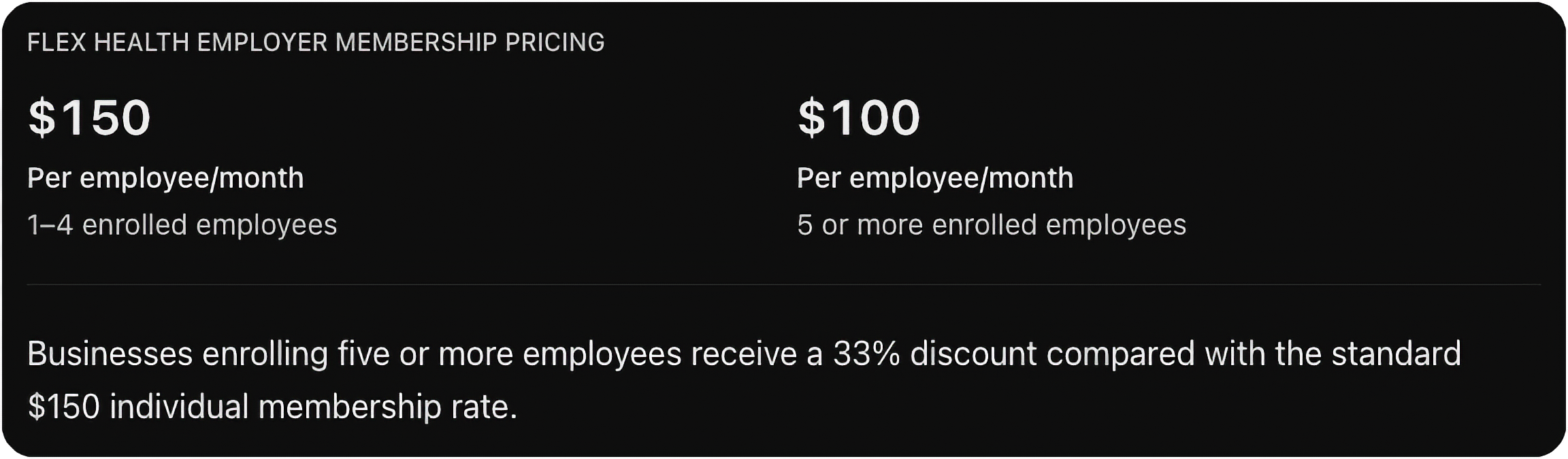
For a business with five enrolled employees, the total membership cost would be $500 per month, or $6,000 annually.
A company with 25 enrolled employees would pay $2,500 per month, or $30,000 annually.
For a larger employer with 85 enrolled employees, the standard group membership investment would be $8,500 per month, or $102,000 annually.
These figures represent membership expenses, not guaranteed savings on insurance premiums or total healthcare spending.
Employers may choose to fund the full membership cost or establish an employee contribution arrangement, depending on their benefits structure and applicable requirements.
Flex Health can work with businesses to discuss their workforce needs and determine an appropriate enrollment arrangement.
A new consideration for Health Savings Accounts in 2026
Beginning January 1, 2026, federal law allows certain qualifying direct primary care service arrangements to coexist with Health Savings Account eligibility.
Under the updated IRS rules, qualifying arrangements are subject to monthly fee limits of $150 for an individual and $300 for arrangements covering more than one person, along with requirements concerning the services provided.
Internal Revenue Service
This change creates additional opportunities for employers interested in combining high-deductible health plans with direct primary care.
Flex Health’s primary care sports medicine model offers services relevant to this approach. However, HSA eligibility depends on the specific membership agreement and applicable IRS requirements, not simply the physician’s specialty designation. Employers should confirm the arrangement’s qualification with their benefits or tax adviser.
7. Why Businesses in Evans, Augusta, and the CSRA Should Consider Direct Care
The Central Savannah River Area is home to a wide variety of businesses, including construction companies, manufacturers, healthcare organizations, professional offices, service providers, and locally owned small businesses.
While these employers operate in different industries, many share the same challenges: rising healthcare expenses, competition for dependable employees, and the need to keep their workforce healthy and productive.
For companies with physically demanding jobs, timely evaluation of musculoskeletal complaints can be especially valuable.
For professional offices, access to preventive care and chronic disease management may help employees address health concerns without repeatedly disrupting their work schedules.
For small businesses that struggle to offer competitive benefits, a direct care membership can provide access to everyday medical services at a predictable cost.
And for employers that already offer comprehensive health insurance, direct care can complement that coverage rather than replace it.
At Flex Health, our goal is to provide a physician-led healthcare relationship that makes sense for both employees and the businesses that support them.
We believe employees deserve convenient access to medical care, and employers deserve healthcare options that are transparent, practical, and financially understandable.
What should an employer consider before starting a program?
Before adding a direct care membership, businesses should evaluate how the benefit will fit into their existing healthcare strategy.
Employers should consider how many employees are likely to enroll, whether they will pay the entire membership cost, and which services are included.
Companies with self-funded insurance should also examine whether the program could reduce medical claims sufficiently to offset some of the membership expense.
Fully insured businesses should evaluate the benefit primarily in terms of employee access, predictable membership costs, and potential longer-term utilization improvements rather than assuming immediate premium reductions.
It is also important to consider employee privacy. Employees should be able to communicate openly with their physicians without worrying that their employers will have access to confidential medical information.
A well-designed employer healthcare program should support employees’ health while maintaining appropriate medical privacy and professional independence.
Conclusion: Better Healthcare for Employees Can Be a Smarter Investment for Employers
For years, employers have focused primarily on purchasing health insurance as their strategy for providing healthcare benefits.
But insurance is only one part of the equation.
Employees also need convenient access to physicians, timely medical evaluations, effective chronic disease management, and appropriate treatment when they become sick or injured.
Employer-sponsored direct primary care offers a different approach.
By providing covered medical services through a predictable monthly membership, businesses can help employees obtain routine care without generating separate insurance claims for every covered office visit.
When combined with traditional insurance, this model may reduce unnecessary fee-for-service utilization while improving access to everyday healthcare.
For some employers, it may also contribute to lower downstream healthcare spending. For others, the greatest value may be employee satisfaction, continuity of care, and a stronger benefits package.
At Flex Health, we combine primary care and sports medicine to help businesses support the health of their workforce.
Whether your company has five employees or hundreds, employer-sponsored direct care deserves consideration as part of a modern healthcare benefits strategy.
Your Employees Take Care of Your Business. Let Flex Health Help Take Care of Them.
Flex Health offers employer-sponsored primary care and sports medicine memberships for businesses throughout Evans, Augusta, Martinez, Grovetown, and the surrounding CSRA.
With group memberships starting at just $100 per employee per month for five or more enrolled employees, businesses can provide personalized healthcare access while maintaining predictable membership expenses.
Discover how Flex Health can help your business offer a more accessible, employee-focused healthcare benefit.
Explore Flex Health’s Direct Care for Employers Program